
New Albany Neighborhoods and ZIP Codes We Serve
We cover all of New Albany, which in practice means the 47150 ZIP code across four zones: Downtown and Riverfront, Midtown, North New Albany, and Silver Hills and West. That includes Mansion Row, East Spring Street, Cedar Bough Place, Crandon Park, Bellemeade, Fairmont, Audubon Place, Blackiston Heights, Blackiston Ridge, Autumn Grove, Autumn Hills, Creekside, Gutford Woods, Silver Hills, Andrew Estates, Brent Heights and Brentbrook. Our broader service areas also include Louisville , Jeffersonville , and Owensboro .
Downtown & Riverfront
Downtown New Albany, Mansion Row Historic District, East Spring Street Historic District, Cedar Bough Place Historic District (47150): masonry basement seepage, groundwater behind the floodwall, and Stachybotrys behind finished walls.
Midtown
Midtown Albany, Crandon Park, Bellemeade, Fairmont, Audubon Place (47150): failed crawl-space vapor barriers, attic mold from blocked soffits, sweating retrofit ductwork, and Falling Run Creek backwater.
North New Albany
Blackiston Heights, Blackiston Ridge, Autumn Grove, Autumn Hills, Creekside, Gutford Woods (47150): downspout and grading failures, condensate dumped under the house, and large garage or estate cleanouts.
Silver Hills & West
Silver Hills, Andrew Estates, Brent Heights, Brentbrook (47150): hillside seepage on uphill walls, stone and rubble foundations, Cladosporium in shaded attics, and steep-driveway access limits.
New Albany Housing and Moisture Conditions
Downtown & Riverfront is the oldest and densest housing in the city. Mansion Row along East Main Street is 19th-century steamboat-era brick, multi-story, over masonry basements never built to be dry. East Spring Street runs the same era in Federal, Italianate, and Victorian styles, and Cedar Bough Place is a very short, exclusive historic street off Ekin Avenue where houses sit close and access is tight. Foundations are brick or stone in lime mortar, often parged with a cement coat that traps moisture instead of letting the wall breathe. The floodwall keeps the Ohio out but does not lower the water table, so in long wet stretches water pushes up through slabs and in at the cove joint. The repeating failure is a basement finished in the 1990s or 2000s over a wall that still weeps: drywall against damp masonry, mold on the hidden side, nobody knows until the smell arrives.
Midtown is mostly postwar bungalows, Cape Cods, and ranches mixed with 1920s frame houses, a few block basements, and many shallow dirt crawl spaces under a plastic sheet laid decades ago and now torn. Falling Run Creek carries hill runoff through this part of town, so low yards near the corridor take backwater that enters crawl spaces through vents and wall joints. Central air added long after these houses were built runs ducts through unconditioned crawls, showing up as mold on the underside of the subfloor.
North New Albany is the newer end of the city, 1970s forward, where slab-on-grade and shallow crawls dominate and houses run 2,000 to 3,500 square feet, which widens scope because there is more crawl, more attic, and more storage. Problems are water management, not construction defect: downspouts discharging at the foundation, negative grade against a rear wall, condensate lines run into the crawl and left there. Creekside and ground draining toward Silver Creek get seasonal groundwater the perimeter drain no longer handles.
Silver Hills & West is the Knobs, developed in the 1800s as a wooded retreat for wealthy families, with large historic homes on steep hillsides and winding roads. Foundations are stone, rubble, or stepped block following the slope, with crawl spaces six feet tall on the downhill side and eighteen inches at the back. Uphill runoff hits the back wall as sheet flow and subsurface seepage, so a wet back wall and a dry front is the signature Silver Hills condition. Heavy canopy keeps roofs shaded and slow to dry, feeding Cladosporium in attics with no ridge and soffit ventilation.
Foundation Types and Typical Solutions in New Albany
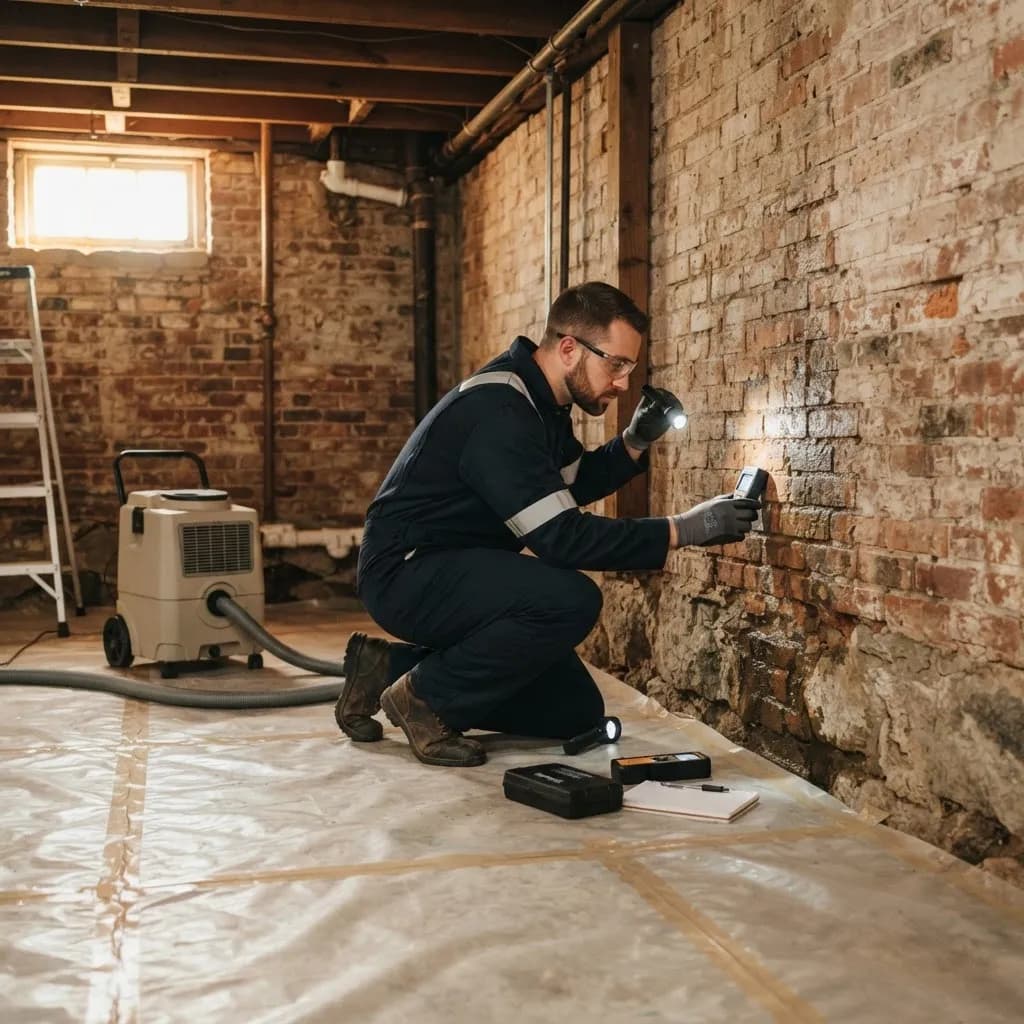
Brick or stone masonry basement (Mansion Row, East Spring Street, Cedar Bough Place): mortar washout, lateral seepage, mold behind finished walls. We remove failed finishes, apply HEPA and antimicrobial treatment, and correct drainage.
Concrete block basement (Midtown, older North New Albany): cove-joint water, block-core saturation, mold on bottom plates. We cut back drywall, treat block, fix the exterior source, and dehumidify.
Dirt crawl space, torn plastic (Midtown, Downtown rear additions, older Silver Hills): ground moisture evaporating upward, joist and subfloor mold. We encapsulate with a sealed liner and vents, plus dehumidification.
Stepped or rubble hillside crawl (Silver Hills, Brent Heights, Brentbrook): wet uphill wall, active seepage during rain. Drainage correction comes first, then encapsulation with matting and a sump.
Slab on grade (North New Albany, newer West side builds): perimeter wicking, mold behind baseboards and in HVAC closets. We do localized removal and moisture mapping.
The Floodwall, Creeks, Knobs, and Seasons
The New Albany floodwall stops river stage but does nothing about groundwater rising behind it. Falling Run Creek carries hill runoff through the older city and backs into low yards and crawl vents in sustained rain, Silver Creek drives seasonal groundwater on the west side, and the Knobs shed water fast, so every home on that slope is downhill from something. River and creek events are episodic and leave a waterline you can point at. Hillside seepage is chronic and leaves only a wet wall and a musty crawl.
Spring is the highest-risk window: saturated ground, frequent rain, and crawl spaces cooler than outside air, so opening vents makes condensation worse. Summer holds Ohio Valley humidity for weeks, condensing on joists and ducts, and any attic with blocked soffits or a bath fan venting into it grows mold. Fall is the best window for encapsulation and drainage work. In winter, stack effect pulls crawl space air upward, so a musty smell that strengthens in cold weather points to a crawl or basement, not an attic. Older homes downtown and in Silver Hills have retrofitted systems with attic air handlers, where an overflowing condensate pan grows mold quietly for a season, while newer North New Albany systems are often oversized and short-cycle without removing enough moisture.
Stachybotrys shows up most in repeatedly wet Downtown and Mansion Row basements and behind finished walls, driven by chronic masonry seepage and a high water table behind the floodwall. Cladosporium favors attics and north-facing framing in Silver Hills, shaded Midtown lots, and crawl joists, driven by poor ventilation, heavy tree canopy, and cool damp surfaces. Aspergillus and Penicillium turn up on damp drywall and stored cardboard and textiles citywide, driven by high indoor humidity and stored goods against cool walls. Naming a genus takes laboratory analysis, not a visual call. What matters for the repair is the water source, the extent, and the materials affected. Health questions belong with your physician.
Mold Inspection in New Albany
Our mold inspection service in New Albany uses moisture readings, a crawl or basement entry, an attic look and an HVAC check, or a walkthrough and volume estimate for a cleanout. The written scope names affected materials, square footage, containment, disposal plan, and price. The inspection and quote are free, with no obligation.
The point is to separate a floodwall-side masonry problem in Downtown from a dirt crawl in Midtown, a water-management issue in North New Albany, or hillside seepage in Silver Hills before the work is priced.
Mold Remediation New Albany, IN: Scope, Standards, and Verification
Our mold remediation service in New Albany is built around the local housing and moisture conditions above. Indiana does not license mold remediation contractors, so there is no state license to check, and anyone with a shop vac can call themselves a remediation company in Floyd County. Ask us, or anyone else, for a written scope naming affected materials and square footage rather than a lump sum for "mold treatment"; documented adherence to IICRC S520 and S500 plus EPA guidance on containment and cleaning; independent third-party verification by a firm that does not do the remediation; and proof of insurance plus a written warranty. Ours is a .
Setup includes containment barriers, negative-air machines with HEPA filtration, floor and stair protection, and a set path to the truck. The work includes removal of affected materials, cleaning of structural surfaces, antimicrobial application and drying, plus drainage, liner, vent sealing, and dehumidifier on encapsulation jobs. Verification continues until materials hit target moisture readings, with independent third-party clearance testing on significant jobs.
Crawl Space Encapsulation in New Albany
Our crawl space encapsulation service in New Albany starts by clearing debris, fallen insulation, and degraded vapor barrier. Correct the water source first: grading, downspouts, exterior drainage, drain tile, or a sump where slope and soil call for it. Remediate growth on joists, subfloor, and piers under containment with HEPA filtration. Install a reinforced liner across the floor and up the piers and walls, sealed at the seams. Seal vents and penetrations, set a dehumidifier sized to the space, insulate as required, and document with photos and moisture readings.
Encapsulation matters most in Silver Hills, Brent Heights, and Brentbrook for hillside seepage, Midtown for dirt crawls with failed plastic, and Creekside for seasonal groundwater.
Junk Removal in New Albany
Our junk removal service in New Albany has to match the zone. Downtown & Riverfront stages from the street or rear alley, with narrow one-way streets, parking pressure, and tight alley turns behind Mansion Row. Cedar Bough Place is street-only staging on a short private historic street with no room to turn a large truck. Midtown works from driveways, streets, and some alleys. North New Albany usually gives us a private driveway and garage. Silver Hills & West requires planning around steep grades, switchbacks, narrow shoulders, and limited turnaround.
Placing a dumpster or staging a commercial truck on a public right of way, the street, an alley, a sidewalk, or a parking lane, generally requires approval. In New Albany that runs through the City of New Albany, and where county roads or unincorporated areas are involved, through Floyd County. Permits typically cover occupying the right of way, lane or sidewalk closure, and traffic control, and historic district properties can carry extra streetscape review. We handle permits, and because requirements, fees, and review times change, our crew confirms current City of New Albany and Floyd County rules before the job is scheduled.
Newer North New Albany subdivisions, including Autumn Grove, Autumn Hills, Creekside, Gutford Woods, and Blackiston Ridge, limit how long a container can sit in a driveway or on the street, and the fines land on the homeowner, not the hauler. Our default is same-day load and go; for multi-day cleanouts we schedule sequential truck days instead of parking a roll-off for a week.
Downtown and Mansion Row homes are three stories with narrow original staircases and tight landings, so we disassemble on site and carry down in pieces. East Spring Street and Cedar Bough Place have limited side yard, so most of the load moves out the front with runners down and corner protection on original trim. North New Albany gives us wide attached garages and level entry. Silver Hills is hardest: long stepped walkways and steep driveways a loaded truck should not attempt, so we shuttle to a larger truck below.
Where Removed Material Goes in New Albany
Usable furniture, appliances, cabinets, and building materials are routed to reuse and charity outlets, including Habitat ReStore-type donation drops in Southern Indiana. Scrap metal, cardboard, paper, plastics, glass, and electronics go to regional scrap and recycling processors and certified electronics channels. Yard waste and clean wood go to regional composting and mulch operations. Paint, solvents, chemicals, and fuels go to household hazardous-waste collection and are never mixed into a general load. Mold-contaminated porous material and true waste are contained, bagged, and taken to permitted landfill disposal. Routing can be documented on request.
Hoard Cleanouts in New Albany
New Albany’s older zones put houses close together, and Downtown, Mansion Row, East Spring Street, and Cedar Bough Place have minimal side yards and, in places, effectively zero-lot-line conditions where a neighbor’s window faces your side door. Our hoard cleanout service in New Albany uses unmarked vans on request with no signage at the property, loads through the alleys behind Downtown and Mansion Row so nothing crosses the front sidewalk, keeps loads covered, schedules off-peak, and briefs crews not to discuss the property or the family with anyone.
Hoarding situations often arrive with paperwork, usually from the Floyd County Health Department, City of New Albany code enforcement, or both. Common triggers are accumulated solid waste, pest harborage, blocked egress, sanitation failures, and exterior accumulation visible from the street, and historic-district properties draw attention faster. On cleanouts tied to citations, we identify which conditions must be corrected and by when, clear those first starting with egress paths and exterior accumulation, photograph before and after so the family has documentation for the inspector, and set haul dates against the deadline. We are a cleanout contractor, not a legal representative, but we get the property to a condition where the inspection passes.
Pre-1940 housing is a large share of Downtown, Mansion Row, East Spring Street, Cedar Bough Place, and parts of Midtown and Silver Hills, and in a heavy hoard that matters. Original joists were sized for the furniture of their era, and dense paper, books, and stacked containers exceed that, showing up as a sagging floor or cracked plaster below, so we check joists and bearing before crews work a loaded upper floor. Knob-and-tube wiring is still present in some untouched historic homes, and combustible material stacked against it is a fire risk we look for first. Hoard material against an exterior wall also hides seepage for years, which is why cleanout and remediation are often scoped together here.
Biohazard, human or animal waste, sharps, and spoiled food get PPE and separate containment, never mixed with a general load, routed to regulated disposal. Pest-infested or mold-contaminated porous material is bagged and sealed at removal, or taken under HEPA containment, to permitted landfill disposal. Heirlooms, photographs, documents, jewelry, and currency are set aside at the sorting station, never bagged blind, and returned to the family item by item. Usable household goods, furniture, and clothing are sorted where condition allows and routed to donation channels. Recyclable metal, electronics, and cardboard are separated at the truck and routed to recycling processors.
The sorting station is the core of the method. We set up a staging area, usually a garage, porch, or cleared room, and nothing leaves until it has passed that station, with a family member reviewing the recovery pile before each load goes out. Cash and documents surface constantly, and a crew that bags without looking throws them away.
What a New Albany Job Looks Like, Start to Finish
Call or book. Reach us at 502-387-8161 or schedule online. We ask about the zone, the age of the home, the foundation type, and what you are seeing or smelling.
Free on-site inspection. Moisture readings, a crawl or basement entry, an attic look and an HVAC check, or a walkthrough and volume estimate for a cleanout.
Written scope and quote. Affected materials, square footage, containment, disposal plan, and price. Free, no obligation.
Scheduling and permits. If staging needs the right of way, we confirm current City of New Albany and Floyd County requirements. If an HOA is involved, same-day load and go.
Setup. Containment barriers, negative-air machines with HEPA filtration, floor and stair protection, and a set path to the truck.
The work. Removal of affected materials, cleaning of structural surfaces, antimicrobial application and drying, plus drainage, liner, vent sealing, and dehumidifier on encapsulation jobs.
Sorting and hauling. Loads separated as they leave, routed to donation, recycling, or disposal the same day.
Verification. Moisture readings until materials hit target, plus independent third-party clearance testing on significant jobs.
Final walkthrough. We review the photo documentation, explain the maintenance that keeps it dry, and hand over the warranty.
Follow up. We check back after the first heavy-rain season, because that is when a drainage correction proves itself.
New Albany Costs and Timelines
These are typical ranges for our Floyd County work, and every price depends on scope, access, contamination, and how much source correction is included. The written quote after a free inspection is the real number.
| Service | Price range | Typical timeline / driver |
|---|---|---|
Mold inspection and written scope | free | 1-2 hours, no obligation |
Single-room remediation | $500-$1,500 | 1-2 days; driven by tile and plaster removal and plumbing access |
Attic remediation and ventilation | $1,500-$4,500 | 1-3 days; driven by roof pitch, Silver Hills tree cover, and soffit condition |
Basement remediation, masonry | $1,500-$5,000 | 2-5 days; driven by finished-wall demolition and floodwall-side water table |
Crawl space remediation only | $5,000-$15,000 | 1-3 days; driven by clearance height and debri |
Crawl space mold remediation | $5,000-$15,000 | 2-5 dayss volume |
$3,500-$25,000 | 2-5 days; driven by square footage, hillside drainage, sump, and dehumidifier size | |
Drainage correction and sump | $1,500-$8,000 | 1-3 days; driven by slope and rock in the Knobs |
Full truck load junk removal | $150-$900 | same day; driven by access, alley versus driveway, and permits |
Whole home or estate cleanout | $5,000-$15,000 and up | 2-6 days; driven by home size, volume, and access |
Hoard cleanout, light to moderate | $1,000-$3,000 | 2-5 days; driven by sorting time and recovery expectations |
Hoard cleanout, severe with biohazard
$4,000-$20,000 and up
4 days to 3 weeks; driven by biohazard handling and structural assessment
Remediation and cleanout scoped together costs less than the two priced separately, because setup, containment, and hauling overlap. Our referral program pays 15 percent up to 500 dollars when you send us a neighbor who books.
Why Local Knowledge Matters in New Albany
The floodwall misleads people. Downtown owners assume flood protection means dry, and finish basements on that assumption. Knowing the wall holds river stage but not groundwater changes how you rebuild.
The creeks behave differently. Falling Run is a fast hill-drainage corridor, Silver Creek a broad seasonal groundwater driver, and the correction near each differs.
The Knobs are a slope problem before a mold problem. Encapsulating a Silver Hills crawl without handling uphill seepage seals moisture in.
Historic districts limit staging. Cedar Bough Place cannot take a full-size truck, and Mansion Row alleys have real turning limits.
North New Albany is a water-management problem, not an old-house problem. Gutters, grading, and condensate lines are the failure points, and fixing those costs less than owners expect.
Indiana’s licensing gap puts verification on you. We work to IICRC S520 and S500 methods and EPA guidance and support third-party clearance testing, because where there is no license, documentation is the only proof.
We are minutes across the bridge, which matters when water is active or a deadline is close.